Reach to cast a spell
Pick a constellation, then touch each star with your fingertip. Stars sit just inside the reach you showed during calibration, never beyond what is safe for you.
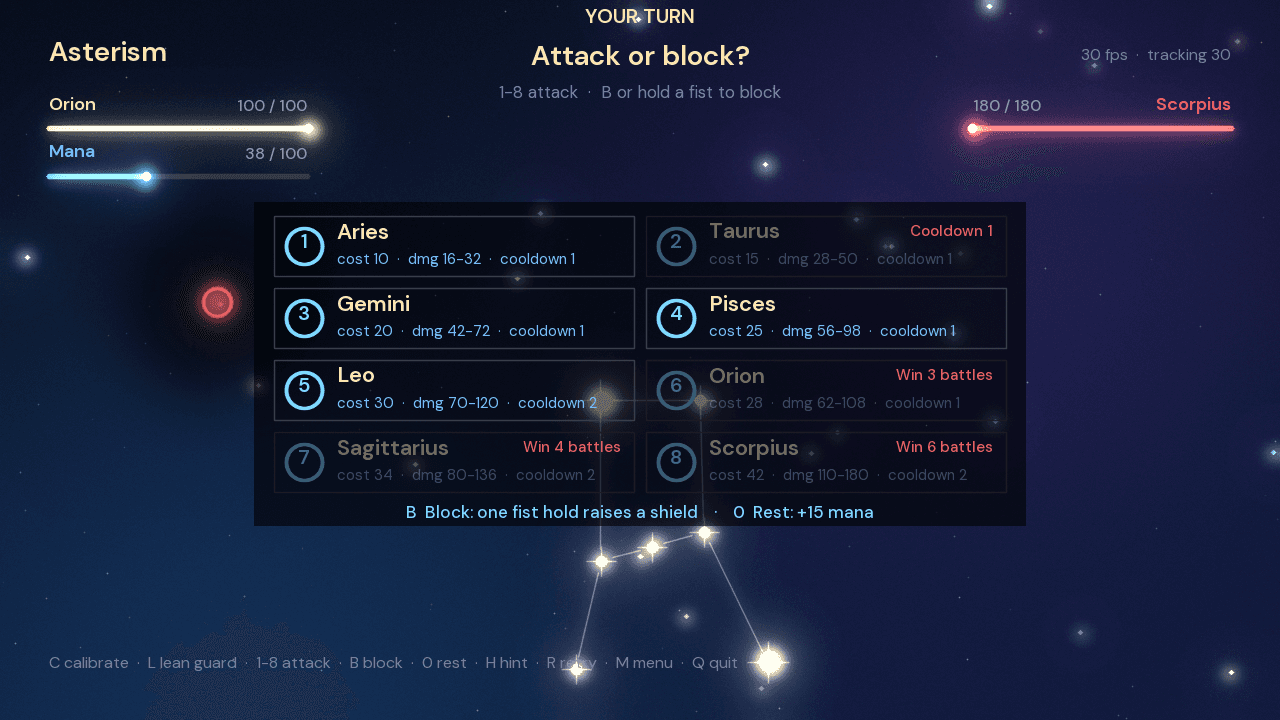
A webcam game for home stroke rehab that turns each repetition into a constellation your therapist can follow.
How it works
Pick a constellation, then touch each star with your fingertip. Stars sit just inside the reach you showed during calibration, never beyond what is safe for you.
The game watches your shoulders. Lean instead of reaching and the star turns red until you sit tall again, so every rep trains the arm, not the habit.
0.4 s
a lean has to last before it counts, so a wobble never does
Each turn you attack or block. A block is one slow fist, held for three seconds, then a wide open hand. Real grip practice, hidden inside a shield.
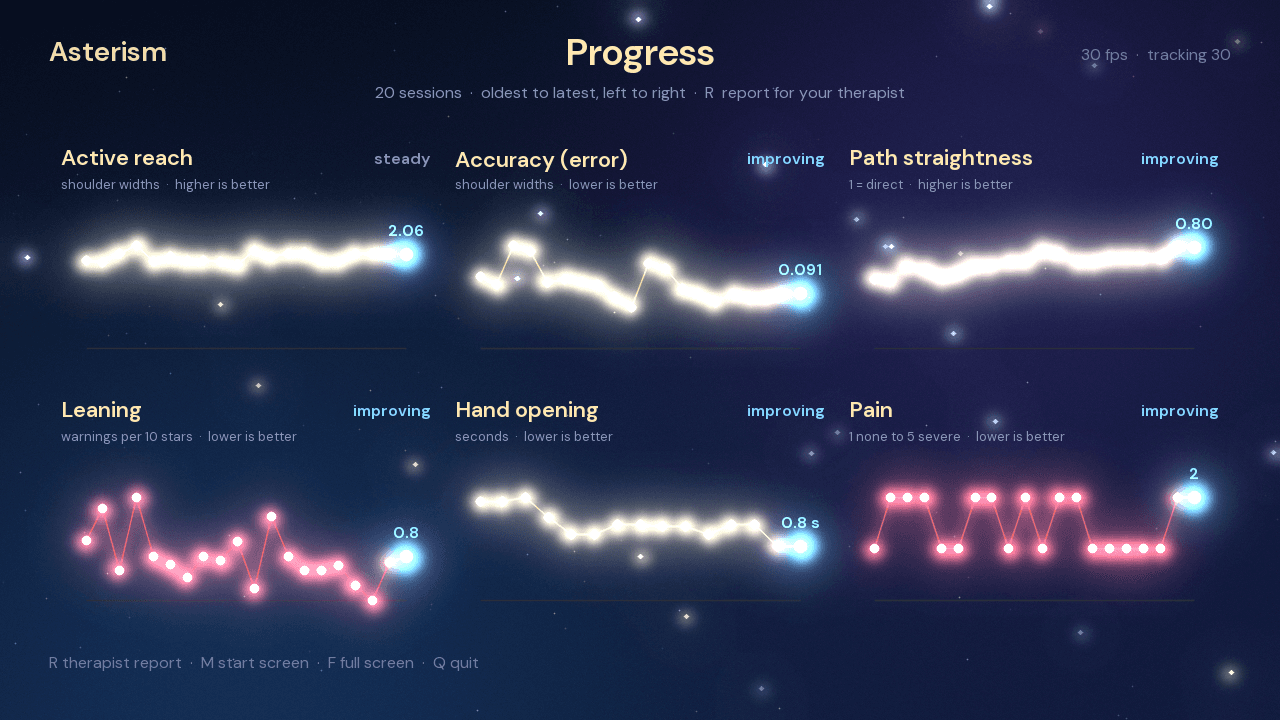
Reach, accuracy, smoothness, tremor and grip are measured every session, with a recorded replay and a report your coach reads from anywhere.
Results so far
We tested Asterism by letting simulated patients play the real game for weeks. The report caught improving reach in one and rising shoulder pain in the other, the two things a therapist most needs to see.
32
battles each, played by two simulated patients over 16 days
9
rehab measures recorded in every session
30 fps
on an ordinary laptop webcam, no extra hardware
Pricing
Free
forever
$29
per month
Let's talk
for teams
Questions
No. A laptop with a webcam and a chair is enough. Sit three to four feet from the screen and the game finds you.
The game never places a star beyond the reach you showed it, warns you when you lean, and asks how you feel after every battle. If you report a lot of pain, it tells you to stop and contact your therapist. It supports your therapy; it does not replace your therapist.
Only patients who link to a coach are visible to them. They see your sessions, a replay of the game screen and your progress report. The replay shows your movement as stars, not your face or your home.
Both. Each run is like a saved world: continue an old one to keep its progress, or start a fresh run any time.